Databricks' new IDE quietly changes how data engineers build pipelines
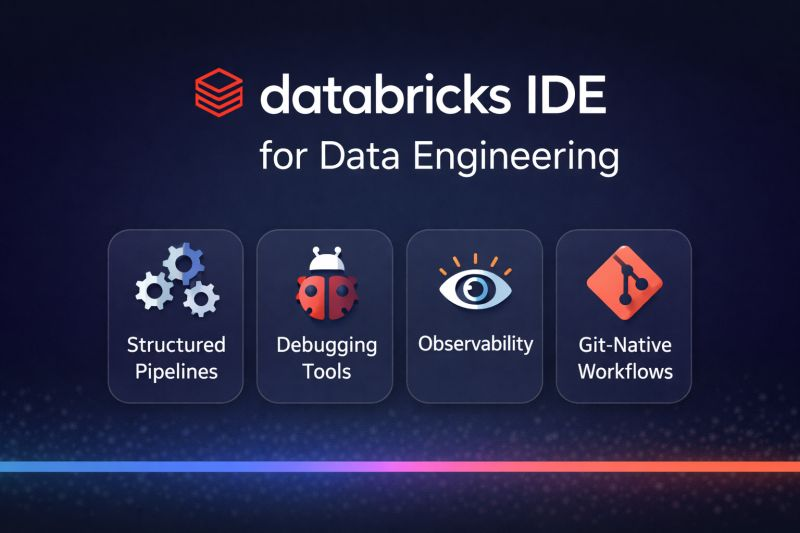
Databricks just changed how data engineers build pipelines, quietly, but in a way that actually matters.
They recently introduced a dedicated IDE for data engineering. And no, this isn't just another UI update.
The pain this is responding to
For a long time, many of us have been building production pipelines using tools that were never really designed for it:
- notebooks that were built for experimentation, not scale
- configs scattered across jobs and repos
- limited visibility into dependencies and lineage
It all works, until it doesn't. The notebook that was perfect for prototyping becomes the thing you're terrified to touch six months later, because nobody's sure what it depends on or what breaks if you change it.
From experiment first to engineer first
This new IDE feels like a genuine shift in posture: from experiment first workflows to engineer first workflows. A few things stood out to me:
- More structured, native pipeline authoring : the pipeline is a first class artifact, not an afterthought wrapped around a notebook
- Better visibility into dependencies and lineage : you can finally see how the pieces connect
- A developer experience closer to real software engineering : the practices we already trust, brought to data
- Git native workflows : instead of stitched together version control
Why this matters at scale
Here's the thing experience teaches you: at scale, most data problems aren't caused by Spark or compute. They come from fragile pipelines, unclear ownership, and poor observability.
Having worked on large migrations and long-running production systems, I've felt this firsthand. Writing the pipeline is rarely the hard part. Maintaining it six months later, confidently, is. The hard part is the change you're afraid to make because you can't see what it touches. Tooling that surfaces lineage and dependencies directly attacks that fear.
This move by Databricks feels like an acknowledgement of that reality.
The bigger picture
Data platforms are no longer optimising just for execution speed. They're starting to optimise for clarity, trust, and long-term maintainability, and honestly, that's where the real leverage lives. A pipeline that runs fast but nobody dares to change is a slow pipeline in every way that counts.
I'm Yash Agarwal, a Data Engineer II at Amdocs in Pune, India. I write about building reliable, large-scale data platforms — migrations, pipelines, and the tooling that keeps them maintainable. You can find more of my work on my portfolio or connect with me on LinkedIn.