The 'SaaS-apocalypse' wasn't a crash, it was a re-pricing of what software is worth
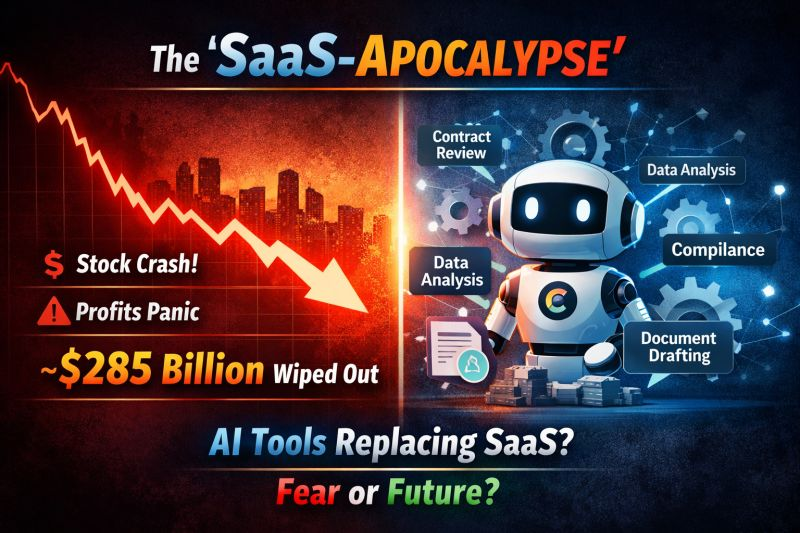
The "SaaS-apocalypse" wasn't caused by a crash. It was caused by a demo.
After Anthropic launched new Claude workflow tools, markets erased roughly $285 billion from software and services stocks in a single session. No outage. No security breach. No bad earnings. Just… fear.
Fear that AI agents are no longer features, that they're becoming full stack replacements for entire software workflows. And investors noticed.
Why this moment feels different
For years, SaaS thrived on a simple, durable model: one tool per workflow, per seat pricing, sticky UIs, and long enterprise contracts. That model printed money precisely because switching was painful and each tool owned its slice of the workflow.
Claude's new tooling quietly challenged that. If an AI agent can read contracts, draft documents, run compliance checks, analyse data, and coordinate workflows, why pay for five separate tools that each do one of those things?
That single question is what people are now calling the "SaaS-apocalypse."
Software isn't dying, it's being re-priced
Let's be clear: this isn't about software dying. It's about software being re-priced.
Markets aren't asking "is this company growing?" anymore. They're asking a sharper question: "Does this company still matter when intelligence becomes the interface?" When the UI stops being where the value lives, a lot of per seat pricing logic stops making sense.
From an engineering perspective, this shift is fascinating
This is where I get genuinely interested, because the future advantage stops coming from the things SaaS competed on. It won't come from feature depth, prettier dashboards, or more configuration screens.
It will come from:
- proprietary data moats : the context no competitor can replicate
- workflow orchestration around AI agents : coordinating many steps reliably, not just calling a model once
- trust, governance, and observability : knowing what the system did, and being able to prove it
- systems that fail safely when the AI gets it wrong : because it will, and the interesting question is what happens next
In other words: less tools, more systems.
That last point is the one I'd underline for any data engineer reading this. An agent that succeeds 95% of the time isn't a product, it's a liability, until you've engineered the other 5%: the validation, the fallbacks, the human-in-the-loop paths, the audit trail. That work doesn't show up in a launch demo. It's exactly the work that decides whether any of this survives in production.
Some analysts are calling the sell off an overreaction. Maybe it is. But one thing is undeniable: AI has forced markets to rethink what software is actually worth, and that conversation has only just started.
I'm Yash Agarwal, a Data Engineer II at Amdocs in Pune, India. I write about building reliable, large-scale data platforms and the systems thinking behind AI in production. You can find more of my work on my portfolio or connect with me on LinkedIn.